
Countries

Classes

Activities

Badge Information

El Jem Amphitheatre

15 
3

El Jem Amphitheatre, Tunisia

(0)0

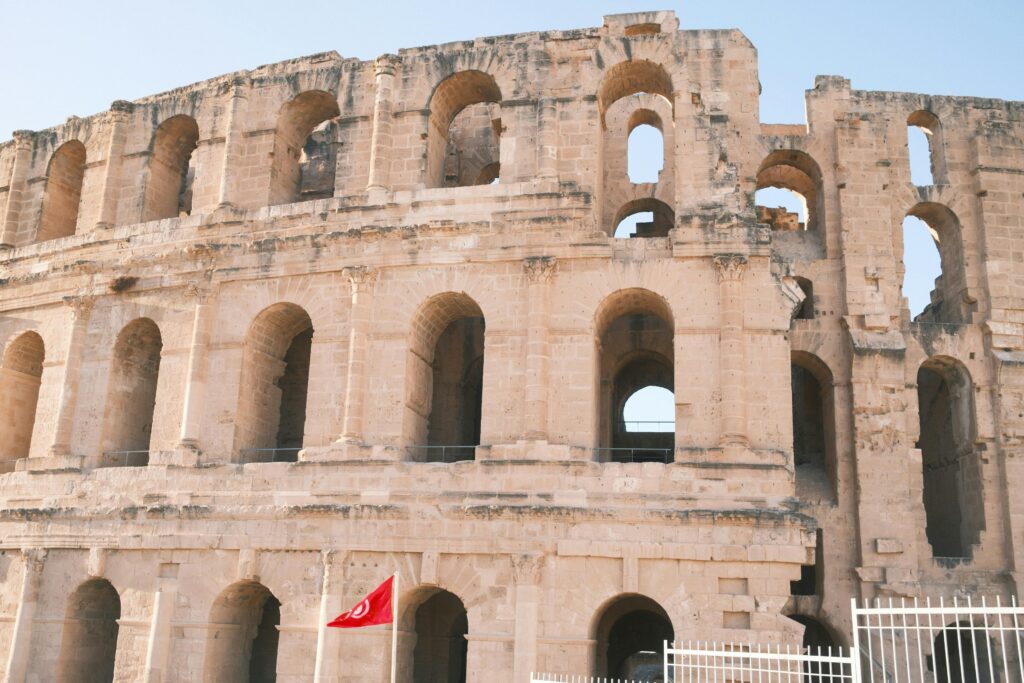
The El Jem Amphitheatre, one of the most significant Roman ruins in Tunisia, is renowned for its impressive size and architecture. Built in the 3rd century AD, it could seat up to 35,000 spectators and is considered a UNESCO World Heritage site. The amphitheatre was used for gladiatorial contests and public spectacles, making it a fascinating site for visitors interested in history and archaeology.

Additional Information

  • Among : One of the best-preserved Roman amphitheatres in the world.

  • Visit Remark : Best visited during the cooler months to avoid the summer heat.

  • Big 5 presence : No, but the region offers unique archaeological experiences.

  • Currency : TND (Tunisian Dinar)

  • Best time to visit :

  • Airstrip(s) :

  • Nearest Town(s) :

Activities

  • historical tours

  • archaeological visits

  • cultural experiences

Suitability

  • Families : Yes, with educational and cultural tours available.

  • Couples : Perfect for romantic historical explorations.

  • Adventure seekers : Great for those interested in history and culture.

  • Business travelers : Yes, with suitable accommodation options nearby.

  • Older adults : Yes, with accessible paths and facilities.

Famous for

  • Roman history : The El Jem Amphitheatre is one of the most impressive Roman ruins in North Africa, known for its historical significance and remarkable preservation.

  • Architectural marvel : This ancient amphitheater, built in the 3rd century AD, is renowned for its grandeur, showcasing the architectural ingenuity of Roman engineering.

  • World heritage site : El Jem Amphitheatre is a UNESCO World Heritage Site, recognized for its cultural and historical importance and its role in the ancient world.

  • Gladiator history : The amphitheater was once used for gladiatorial combats and other public spectacles, and it is said to have been a venue for events similar to those in Rome's Colosseum.

  • Cultural events : Today, El Jem hosts cultural events and festivals that celebrate its historical heritage, including music performances and reenactments.

Visiting Tips

  • Best time to visit : The best time to visit El Jem is during the cooler months from October to April, when the weather is more comfortable for outdoor exploration.

  • Guided tours : Consider taking a guided tour to fully appreciate the history and significance of the site. Guides often share fascinating stories about its construction and use.

  • Photography : El Jem is an excellent location for photography. Visit during the golden hour for stunning photos of the amphitheater bathed in warm light.

  • Wear comfortable shoes : Wear sturdy, comfortable footwear as you will likely be walking on uneven, ancient stone surfaces.

  • Respect the history : Be respectful of the site and its historical significance. Avoid climbing on restricted areas and follow all site rules and regulations.

Security and Safety

  • Personal safety : El Jem is generally safe for visitors, but as with any tourist attraction, stay aware of your surroundings and keep your belongings secure.

  • Health preparedness : Bring water and stay hydrated, especially if visiting during the warmer months. Sunscreen, a hat, and sunglasses are essential for sun protection.

  • Weather preparedness : The weather in Tunisia can be quite hot, so it's best to plan your visit in the early morning or late afternoon to avoid peak sun hours.

  • Emergency contacts : Keep emergency contact numbers handy and know the location of the nearest hospital or clinic in case of any health concerns.

  • Respect local customs : When visiting El Jem, show respect for the local culture and customs. Modest dress is encouraged, especially when interacting with locals or visiting nearby places.

Recommended Clothing

  • Layered clothing : If visiting during cooler months, layer your clothing to adjust to varying temperatures throughout the day.

VISA Requirements

  • Entry requirements : Travelers may need to show proof of sufficient funds and possibly complete a customs declaration upon arrival in Tunisia.

Business information

  • Most destinations typically operate between 07:AA-19:BBhrs & open 7days a week. However, for busy destinations they are open for 24hrs & 7days a week.Then for none-busy destinations they operate in select few days & close on holidays and weekends.For further information please lias with your tour operator for smooth visits. You can also contact the destination offices directly with the following details

  • N/A (Contact the National Heritage Institute - INP)

  • ontt@discovertunisia.com (Tunisia Tourism Office)

  • N/A (Contact the National Heritage Institute - INP)

NB: Not all listed contact details and website may be operationally-valid. We encourage further verification during trip planning and if found not working, please use our community forum to indicate the issue.

Select Tour operator

Select your location to load relevant tour operator(s) from your country to take you to this selected destination

Searching for Tour operators, please wait...

✦ CONTINENTAL LOGISTICS ENGINE ✦

The Ultimate Pan-African Route Constructor.

Design complex, multi-country African expeditions instantly. Our autonomous engineering matrices optimize overland tracks, calculate precise bush-flight sectors, and chart localized border-crossing strategies.

🛣️ Highway Mode Active: Engine optimizing for paved highway tracks baseline metrics.
⚠️ Warning: High profile will remove all destinations below the desired popularity-score
0 km
Current Selection: 250 km
1000 km
Ready to map network pipelines... Click the run engine button above.
📊 Combined Journey Matrix
--
🛣️ Total Overland
--
✈️ Est. Air Time
--
⏱️ Road Transit
--
⛽ Fuel Demand
--
💵 Est. Operational Fleet Cost
$0.00 USD
💡 Logistics & Trip Planning Advisory Note
Metrics evaluate continuous ground transit parameters. Airborne legs are excluded from calculated fuel loads.
✈️ Note on Fly-In Options: While local wilderness bush airstrips should be actively evaluated if present on the itinerary, this mapping matrix defaults exclusively to ever-present overland short-leg means.
📋 Your Organized Chronological Journey Sequence
Essential Planning Guide

How to Structure a Secure African Itinerary

Rule of Thumb: Aim for 1 to 2 destinations per country to avoid scams and travel fatigue.

Core Guidelines

  • Limit countries: Maximize 2 to 3 countries per trip.
  • Scale risk: Excess destinations expose you to transit challenges.
  • Pacing: Spend at least 7 days per region.
  • Transport: Avoid unregulated transport and unlicensed guides.
  • Vetting: Check operators with ATTA or SATSA.
  • Transit: Book airport transfers directly through lodges.
  • Airlines: Stick to trusted carriers e.g Airlink or Ethiopian.
  • Classic Combinations: Focus on complementary pairings within the same region to minimize logistical stress.

Recommended Pairings

🏛️
North Africa: Morocco paired with Egypt (ideal for history/varied landscapes), or Morocco with Tunisia (easier logistics, deep Roman and Islamic history).
🦁
East Africa: Kenya paired with Tanzania, or Rwanda with Uganda (perfect for gorilla trekking and rich African safaris).
🎭
West Africa: Ghana paired with Togo and Benin (the classic Voodoo and heritage route, easily done via overland border crossings).
🦍
Central Africa: Republic of the Congo (Odzala-Kokoua) paired with Central African Republic (Sangha Trinational) for lowland gorilla and wildlife expeditions.
🌊
Southern Africa: Cape Town paired with Kruger National Park and Victoria Falls (the classic bush, beach, and waterfall route, easily linked via direct regional flights).
🏝️
African Islands: Mauritius, Seychelles, and Zanzibar (distinct mix of luxury, adventure, and cultural heritage).
🌍🤝

Thank You for Your Support!

The Ultimate Pan-African Route Constructor is a passion project built by Tour Africa LLC to empower mapping, travel, and connectivity across Africa. If this platform has brought you value, please consider supporting our work. Your donations help keep this tool free, update crucial mapping data, and build better resources for travelers worldwide.

Support Our Mission
v1.0.0